
Creator brand-deal readiness guide
What should a creator include in a media kit?
A useful media kit helps a brand decide whether your audience, examples, deliverables, and working boundaries fit the inquiry. It should not be a pile of impressive numbers or a promise that changes from one conversation to the next. This guide gives you a 24-point readiness score, a one-page kit specification, and a send-or-repair decision before the document reaches a buyer.
Decide whether a media kit is ready to send
A creator media kit is ready when a brand can understand who the creator reaches, why the audience fits, what the creator has made, what the proposed work includes, and which questions still need a conversation. Include a current introduction, audience context, selected examples, deliverable options, working boundaries, contact details, and a date checked. Leave out unsupported performance promises, copied testimonials, stale screenshots, and a price that pretends every campaign has the same scope.
Start with the buyer's decision: “Can this creator plausibly reach the right people with a deliverable we can approve, measure, and use under agreed terms?” A media kit supports that decision; it does not replace a brief, contract, disclosure, or quote. The FTC says endorsements must be truthful and material relationships must be disclosed. YouTube likewise describes brand deals as partnerships and requires creators to declare paid promotions in the relevant content.
One page of follower totals
The buyer cannot tell who the audience is, which examples are comparable, what the creator will deliver, or whether the numbers are current.
One decision-ready evidence set
The buyer can see audience fit, recent work, a small set of scoped options, proof dates, boundaries, and the exact questions that belong in the next reply.
Use the brand-deal pricing guide when the buyer asks for a quote. Use the custom-request guide when the inquiry changes the deliverable, deadline, rights, or revision burden. The media kit should create a clean handoff to those decisions, not hide them. To find brands and pitch them in the first place, see how to get brand deals as a small creator.
Choose the sections a buyer actually needs
A media kit can be short and still complete. Build it around evidence that changes the buyer's decision, then remove anything that only makes the deck feel fuller. The following structure works for a focused inbound inquiry and can be expanded when the campaign requires more detail.
Who you reach
Describe the niche, geography or language where relevant, audience problem, and the kind of brand relationship that fits your work.
What you can show
Choose three to five recent examples with format, date, role, and a short reason each example is comparable to the inquiry.
What you can deliver
State a small menu of deliverables with format, review points, turnaround assumptions, and what is not included.
What the numbers mean
Label the platform, time period, sample, and source for audience or performance figures. Do not present a snapshot as a guaranteed result.
Where judgment remains
Flag usage rights, exclusivity, revisions, disclosure, payment, product claims, and any requirement that needs a brief or contract.
| Section | Include | Do not imply |
|---|---|---|
| Introduction | Niche, point of view, audience problem, contact | That every brand is a fit or that a personal story is a measurable outcome |
| Audience | Relevant audience context and the period checked | That follower count alone equals reach, trust, or purchase intent |
| Examples | Recent work with format, date, role, and comparable context | That an old viral result will repeat for a new brief |
| Deliverables | Scoped options, review points, timing assumptions, exclusions | Unlimited revisions, perpetual access, or unpriced add-ons |
| Commercial notes | Starting point or “quote after brief,” rights questions, disclosure note | That a starting price is a final quote for every usage and deadline |
A buyer may ask for a rate card, but a rate card is not the same as a media kit. Keep the evidence document and the quote logic connected without pretending that production, usage, exclusivity, rush work, taxes, or revision scope are identical across campaigns. The kit can say “starting at” or “quoted after brief” when that is the honest boundary.
Score the kit before the inquiry arrives
Score each criterion 0, 1, or 2. Zero means the evidence is missing or unsafe to state, one means it is plausible but needs a narrow repair, and two means the creator can point to the current source or document the boundary. The maximum is 24 points. This is a send-readiness check, not a quality rating for the creator.
| Criterion | 0 points | 1 point | 2 points |
|---|---|---|---|
| Audience fit | Niche or buyer is vague | A broad audience is named | The relevant audience problem and context are specific |
| Audience evidence | No source or date | A dated snapshot exists | Platform, period, sample, and limitation are labeled |
| Recent examples | No comparable work | One old or loosely related example | Three to five recent, explained examples |
| Deliverable scope | “Anything you need” | Formats are listed but limits are unclear | Options, review points, timing, and exclusions are stated |
| Rights boundary | Usage is implied to be unlimited | Organic and paid use are mentioned | Usage, term, territory, whitelisting, and exclusivity are quote questions |
| Disclosure readiness | No disclosure plan | Platform labels are mentioned | The creator knows that the content and relationship need clear disclosure |
| Claim safety | Results or product claims are unsupported | Claims are plausible but unverified | Only creator-owned, sourced, or approved claims are used |
| Currency and contact | Stale file or unclear owner | Last checked date is present | Owner, review date, contact, and next step are current |
| Price boundary | Copied or guaranteed price | Starting point is shown | Quote conditions and change variables are explicit |
| Review path | No way to approve changes | Creator reviews when available | Scope, rights, payment, safety, and uncertainty always return to the creator |
| Brand fit | Any sponsor accepted | Some categories are excluded | Values, audience fit, and category exclusions are visible |
| File usability | Unreadable or link-heavy | Usable with explanation | Readable on mobile, links resolve, and the version is named |
Interpret the total conservatively:
Ready to send
Send the current version for a matching inquiry, then move scope and terms into a brief or direct conversation.
Repair one weak section
Fix the lowest score before treating the kit as a reusable answer. A narrow kit is better than a broad document with unknowns.
Do not use it as proof
Collect current evidence and define the deliverable before the next buyer sees the file.
Pause the send
Any unsupported product claim, stale performance number, hidden rights promise, or missing disclosure plan blocks the kit even if the total is high.
Save the score with the kit version. If the audience snapshot changes, a platform rule changes, or the creator adds a new deliverable, score the affected section again. Do not silently edit a shared file while a live inquiry is using the old version.
Make claims, rights, and disclosures precise
The most dangerous part of a media kit is often the sentence that sounds impressive but cannot be defended. The FTC says a material connection can include payment, free products, employment, or other value, and that a disclosure should be clear and hard to miss. YouTube requires creators to declare paid promotions and says paid content must follow platform and legal rules. TikTok's branded-content policy also places disclosure responsibility on the creator. A kit should prepare the creator to discuss those requirements, not promise that a platform label solves every obligation.
Creator-owned fact
“I publish weekly field notes for independent gardeners.” The creator can approve and update this statement.
Use in the kit: point of view and current practice.Measured evidence
“Last 90 days, 42% of viewers were in the United States.” Add the platform, date range, and measurement source.
Use in the kit: audience context with a visible limitation.Campaign condition
Paid usage, exclusivity, whitelisting, rush delivery, and revision rounds depend on the brief and contract.
Use in the kit: a question, not an unpriced promise.Product or legal claim
Health, safety, performance, earnings, or comparative claims need evidence and approval. Do not let a standard reply guess.
Use in the kit: “confirm before publishing.”| Buyer asks | Kit can answer | Creator must confirm |
|---|---|---|
| Who sees your work? | Niche, geography, language, age or interest context when sourced | Whether the current campaign audience truly matches |
| What can you make? | Examples and bounded formats | Brief, production requirements, revisions, deadlines, and acceptance |
| Can we use the content? | That usage terms are discussed separately | Term, territory, media, paid amplification, whitelisting, and exclusivity |
| What results will we get? | Past, labeled observations with a date and source | Any forecast, guarantee, product claim, or campaign KPI |
| How will it be disclosed? | That paid or gifted relationships are disclosed clearly | Exact platform treatment, copy, placement, and legal review |
Do not let a kit become a hidden contract. If a brand asks for a perpetual license, exclusivity across a category, a guaranteed number of clicks, or a product claim outside the creator's experience, pause and write the question down. The creator monetization funnel is useful for separating qualified interest from a completed agreement, and the free creator tools can help estimate repeated conversation work without turning the kit into a sales forecast.
Work through a niche creator example
Imagine a gardening creator who publishes balcony-growing experiments. A sustainable-seed company asks for a “quick collaboration deck” after seeing a recent post. The creator has 18,400 followers, but the number alone does not decide whether the kit is ready. The relevant evidence is who engages, which examples match the product, what the creator can deliver in a protected week, and whether the brand's desired usage fits the creator's boundaries.
The kit names apartment gardeners and container-growing beginners as the primary audience, then labels the platform dashboard period used for the audience snapshot.
It selects three recent posts: a seed-starting experiment, a balcony harvest walkthrough, and a failed test that explains what changed. Each example includes format, date, and why it is comparable.
The creator offers one short-form demonstration, one story sequence, or a bundled package with a defined review round. A second revision, raw footage, and paid usage are quote variables.
The kit says paid or gifted relationships will be disclosed in the content and that the exact platform treatment and copy will be confirmed before publication. It does not imply that a brand can conceal the relationship.
The creator scores 21 of 24. The hard stop is clear: a request for perpetual paid usage pauses the send. For the original organic-only inquiry, send the kit and ask for product, timing, deliverables, usage, exclusivity, and approval details.
The example does not promise sales, reach, or a campaign result. It gives the brand enough evidence to decide whether to brief the creator and gives the creator enough structure to avoid quoting a vague “collaboration.” If the creator later accepts a gifted product, the relationship and content treatment still need a clear disclosure under the applicable rules.
Current versionBalcony garden media kit, checked September 6, 2026
AudienceApartment and small-space gardeners, with dashboard period and platform labeled
ExamplesThree dated posts with format, role, and comparable campaign reason
OptionsOne demonstration, one story sequence, or a scoped package after brief
Not includedPerpetual usage, category exclusivity, raw footage, unbounded revisions, or guaranteed results
Next stepRequest the brief and confirm product, timing, usage, disclosure, approval, and payment terms
Choose send, repair, or decline
A media kit is a routing artifact as much as a sales document. Use the inquiry and the readiness score together. The creator should remain the decision owner for a new claim, a new category, a material rights request, payment, a safety issue, or any uncertainty.
- Step 1
Match the inquiry
Name the brand, product category, audience, channel, deliverable, and timing. If the inquiry does not contain enough information to identify the job, ask for a brief.
- Step 2
Check the kit version
Confirm the audience evidence, examples, offer options, contact, and review date. Remove stale numbers or examples before sharing.
- Step 3
Route the risk
Send standard fit facts from the approved kit. Hand off scope, rights, exclusivity, product claims, payment, disclosure wording, and unfamiliar requests.
- Step 4
Choose one next action
Send the kit, repair one section, ask for the brief, decline the category, or pause until the creator can review the terms.
| Inquiry state | Action | Reason to record |
|---|---|---|
| Specific, matching, low-risk | Send the current kit and ask for the brief | The kit answers fit while the brief defines the work |
| Good fit, stale evidence | Repair the affected section before sending | A current claim is safer than a polished outdated file |
| Vague “collab” request | Ask for product, channel, deliverable, timing, usage, and budget process | You cannot price or promise a campaign from one vague sentence |
| Unsupported claim or risky category | Pause and route to the creator, or decline | Trust and compliance matter more than filling a pipeline |
| Perpetual or unclear rights | Do not send a final quote; confirm terms directly | Usage can change the economics and future availability of the work |
Keep a small record of which version was sent, what the buyer asked next, and where the creator had to clarify. That evidence improves the kit without turning one inquiry into a universal claim. If the same question arrives repeatedly, add a precise answer only after the creator approves it.
Research notes
Sources checked for this guide
Product details and policies can change. First-party pages were checked on September 6, 2026.
- Federal Trade Commission: Endorsement Guides questions
The FTC's current staff guidance explains material connections, truthful endorsements, and why disclosures must be clear when a creator has a relationship with a brand.
- Federal Trade Commission: Disclosures 101
The FTC's influencer guide explains where and how disclosures should appear and warns creators not to rely on vague shorthand or a profile-page disclosure alone.
- YouTube Help: tips for getting brand deals
YouTube describes brand deals and branded content as partnerships that should fit the channel and reminds creators that free products or payment can trigger disclosure obligations.
- YouTube Help: paid product placements and sponsorships
YouTube documents the paid-promotion declaration and the need to follow platform advertising rules and applicable legal obligations.
- TikTok Help: branded content policy
TikTok's first-party policy explains branded-content disclosure and creator responsibilities when content promotes a third-party brand or business relationship.
Questions creators ask next
Direct answers that keep the plan realistic.
Does a creator need a media kit to get brand deals?
No. A relevant portfolio and a clear reply can be enough for a small or exploratory inquiry. A media kit becomes useful when a buyer needs the same evidence repeatedly or when the creator wants to qualify a request before discussing scope.
Should a media kit include a rate card?
Only if the rates are current, scoped, and easy to distinguish from a final quote. A rate card can show starting prices or common packages, but usage rights, exclusivity, revisions, rush work, taxes, and production requirements can change the final quote. Use the brand-deal pricing guide for the quote itself.
How many pages should a creator media kit be?
Use the shortest document that proves fit and answers the buyer's next questions. For a focused inquiry, one or two pages may be enough. A longer deck is justified only when each page helps the buyer evaluate audience, examples, deliverables, or terms.
Should follower counts be the main part of a media kit?
No. Include current audience and performance context when it is relevant, but pair it with audience fit, recent examples, deliverables, and clear limitations. A large total audience does not prove that a specific campaign is a good fit.
Can Loresta send a media kit automatically in a DM?
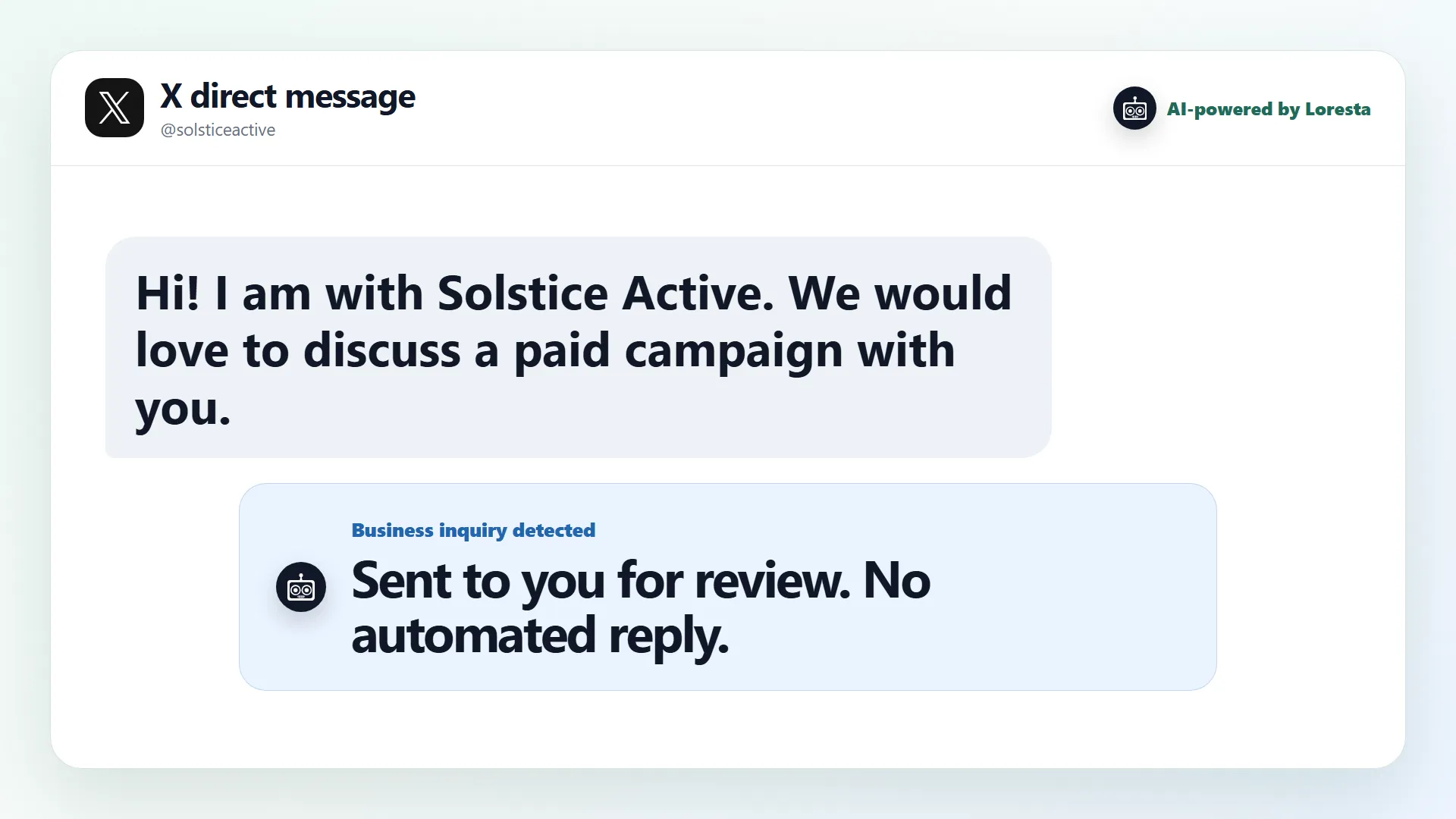
Loresta can route a standard request to an approved, current destination, but a brand inquiry involving scope, rights, payment, exclusivity, or a new claim should return to the creator. The kit is a source of approved facts, not permission for an assistant to negotiate a deal.
Keep the approved kit close to the conversation
Claim your name and paste your link. Loresta builds a free Page for tips, offers and answers to your followers' questions. Nothing goes live until you publish.
Compare plans